In the News: Crowdsourcing WWI Diaries

Screen Shot 2014-11-20 at 5.08.02 PM

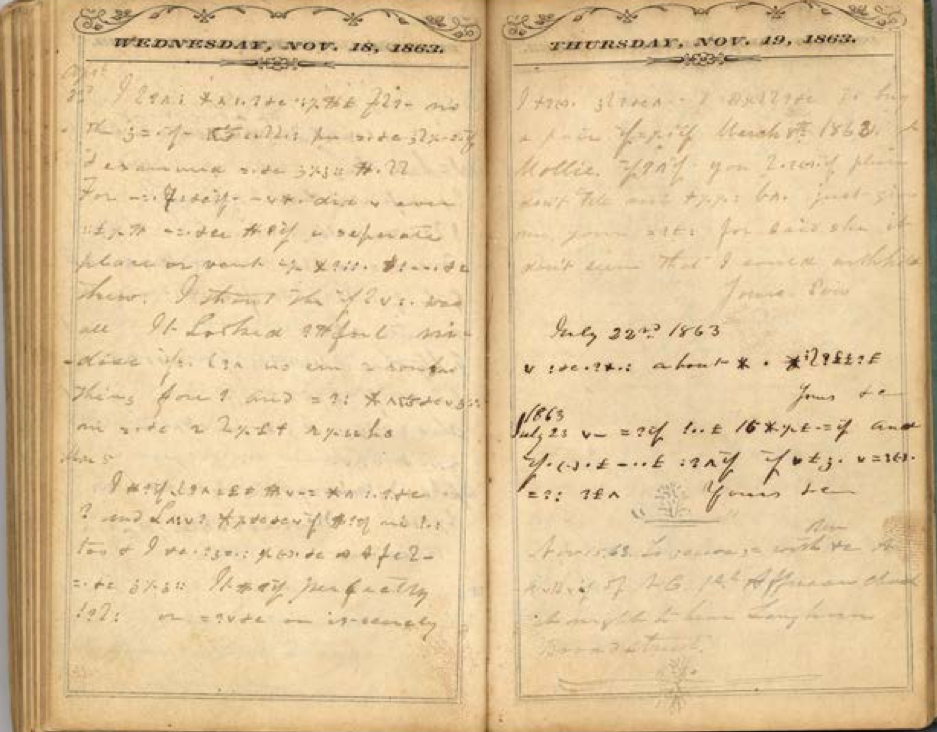
It’s a fascinating idea: Digitize thousands of WWI diaries and invite the public — dubbed “citizen historians” — to annotate the documents. And, do it not under the aegis of a traditional academic institution or public sector organization but rather a newfangled quasi-academic, quasi-digital corporation: Zooniverse. It is a creative way of engaging amateurs in the work of historical research and the digital platform (from my brief exploration) is easy to use. I think that the pre-determined tags are limited and that a trained historian or literary critic would ask much more complicated questions about the content and significance of the documents than a simple tag can communicate. But, really, why quibble with the details when the project is so ambitious and impressive in its scope?

Zooniverse’s Operation War Diary

A BBC News article on the project, “Digitized WWI Diaries Highlight Battle Confusion”

CFP: After Print: Manuscripts in the Eighteenth Century

After Print: Manuscripts in the Eighteenth Century
UC Santa Barbara
April 24, 2015
Co-sponsored by the Mellon Fellowship in Critical Bibliography at Rare
Book School and the UCSB Early Modern Center

This one-day conference at UCSB will bring together junior and senior
scholars to explore the continued vitality of manuscript publication
and circulation in the eighteenth century. Scholars now often take for
granted that the eighteenth century constituted an established ?print
culture,? whether that culture was inherent in the technology or
forged by its users. By the age of Addison and Pope, this narrative
contends, the spread of print and lapse of licensing had rendered
superfluous a manuscript world of scurrilous libels, courtly poetry,
and weekly newsletters. But a growing body of research is arguing for
the ongoing importance of manuscript production and publication into
the Romantic period, and for a critical stance that questions the
solidity of the print-manuscript binary. In texts from diaries and
journals to notes, letters, sheet music, scientific observations, and
hybrid multimedia documents, scholars are turning their attention to
the manuscript traditions and innovations that were also central to
eighteenth-century literature. And they are drawing connections to our
own moment of protracted media shift, focusing on aggregative,
iterative steps rather than a single “revolution.”

“After Print” will join this exciting subfield by exploring a range of
manuscript practices in the long eighteenth century. Margaret Ezell,
distinguished professor of English and Sara and John Lindsay Chair of
Liberal Arts at Texas A&M University, whose works Social Authorship and 
the Advent of Print (1999) and The Patriarch’s Wife: Literary Evidence 
and the History of the Family (1987) have been foundational to the
field will deliver the keynote lecture on Friday evening. Proposals
are solicited for papers on any aspect of eighteenth-century studies
related to the theme; in particular, proposals are welcomed from
junior scholars (graduate students, postdocs, and untenured faculty)
for a special panel on new methods. Limited travel support for junior
scholars may be available.

Please send paper proposals by Dec. 15 to Rachael Scarborough King
(Asst. Prof. of English, UCSB), rking@english.ucsb.edu.

In the News: Dr. Livingstone’s 1871 Field Diary In Living Color

Screen Shot 2014-11-07 at 5.48.33 PM

Screenshot of a page of Dr. Livingston’s diary, via the UCLA Multispectral Critical Edition

Yes, that Dr. Livingston.

The David Livingston Spectral Imaging Project at UCLA has succeeded in rendering Livingston’s fragile and mostly illegible diary available for modern readers. Livingstone wrote his diary on newspaper print with ink he made from berries. The Spectral Imaging Project not only makes the text legible, it has transcribed and digitized the entire document, and made it accessible on the web for free. The project is an impressive realization of the promise of digital humanities.

Read an account of this project at the Smithsonian Associates.

UCLA’s David Livingston Spectral Imaging Project

In the News: Keeping a Necrology

Physician John Henning Schumann describes his practice of recording the names of all the patients he has treated who have died, a kind of adapted diary which he calls a necrology:

In everyday medical care, the practice of reflection is too often overlooked. Remembrance is what makes us human. Somehow, keeping tabs on who has died over the years keeps me humble. It also reminds me that in spite of all of medicine’s marvels, and whatever I might be able to do, our patients all eventually die.

Read Dr. Schumann’s essay here, via NPR.

Book Review: Belzhar by Meg Wolitzer

Belzhar by Meg Wolitzer (Dutton Books, 2014)

Diary Index Book Reviews focus on the role and representation of diaries or journals in contemporary fiction. Warning: may contain spoilers.

Early in Wolitzer’s new young adult novel, five troubled teenagers are given journals and instructed to write in them regularly. They receive this assignment because they are members of a specially selected group of students in a Special Topics in English class at Wooden Barn, a school for teens like themselves – just angst-ridden enough for dramatic purposes but not so authentically troubled as to be unreachable or unrecoverable. There is a great deal of “specialness” in Belzhar and the journals play a key role in demarcating who possesses this quality: only a handful of teens are given the journals, which are magically imbued with an ability to transport them to an idealized moment in the past before their trauma has occurred.

In Wolitzer’s imagined universe, journaling puts one in a particular time and place, a place all the teens want to return to but one governed by rules they must slowly discern; they cannot control how long they remain in this place (which they call “Belzhar” in tribute to Sylvia Plath’s Bell Jar) and, because the physical journal is finite, so too are their visits: they will only be able to go there a specific number of times. Journaling is imagined in a conventional way: the journals are red leather-bound books with lined pages and the students write in them with pen or pencil. It is consistent with the setting at Wooden Barn, where cellphones are banned, but it contributes to the quaint, old-fashioned tone of the novel that the moral seems to be that writing in longhand leads to self-discovery and healing. (I pity all the troubled teens who will be handed this book alongside a journal and exhorted to write themselves to mental health.) Moreover, journaling takes the teens to a place where progress is impossible: it is rooted in the past and no new things can occur there without dreadful consequences. Journaling is paradoxically an activity that keeps one resolutely and morbidly tied to the past, and yet also the necessary step towards future recovery.

I am a great fan of Wolitzer’s previous novel, The Interestings, which was set at a summer camp for talented and artistically-inclined teens – a setting that very closely parallels the special school for troubled teens in Belzhar. Comparisons between the two novels seem inevitable and much to the detriment of Belzhar. Belzhar reads like a formula: Take setting and characterization from The Interestings, water it down for a YA audience, add a dash of the supernatural and a lite intertextual reference to Plath and, voilà, a YA bestseller! The treatment of harrowing trauma as a mere passage in teenage self-discovery invites such a cynical reading. Journaling is the primary metaphor for this process of self-discovery, but it is not taken seriously as a creative, literary, or psychologically beneficial act – which is indicated by the fact that recovery is equated with no longer needing to journal. The teens hand over their journals at the end, having completed the assignment of wrestling with their inner demons – no longer in need of the tedious activity of writing because they are somehow, magically and improbably, cured. There may be some young readers who will buy this lesson but I think most will find the novel’s premise as flat and unpersuasive as I did.

In the News: Confederate Diary De-Coded

Screen Shot 2014-10-19 at 8.48.27 PM

Via Huffington Post: A British Cryptographer has decoded a US Confederate soldier’s diary to discover that the code was intended to hide the soldier’s gossipy speculation about his superiors.

The complete diary of Lt. James M. Malbone is viewable here, thanks to the New York State Military Museum.

Kent D. Boklan’s account of his decoding process is available here, via Taylor & Francis (limited access).

What’s the difference between a diary and a journal?

A diary is a journal but a journal is not a diary.

The dictionary yields this curious logic. According to the Oxford English Dictionary, a diary is “a daily record of events or transactions; a journal,” a meaning it tracks back to 1581. But, the OED entry on the word “journal” does not employ the term “diary” except in a sub-entry and as a negative example: The journal is a “a record of events or matters of personal interest kept by any one for his own use” — which sounds an awful lot like a diary, were it not followed by this disclaimer: “Now usually implying something more elaborate than a diary.” Instead of using “diary” to define “journal,” the OED provides a host of other comparative terms including: day-book, record, service-book, itinerary, account book, logbook, daily newspaper, etc.

The journal, it seems, is many things, while a diary is only one thing, though that thing is very like a journal. Which is many things.

“Journal” has a number of other rich, sometimes obsolete associations: religious, nautical, financial, legal, mechanical, related to mining, related to travel. My favorite is the use of “journal” (from the French) to refer to the amount of land that can be plowed in one day. What a wonderful metaphor for the work of keeping a daily diary: how much land did you plow today?

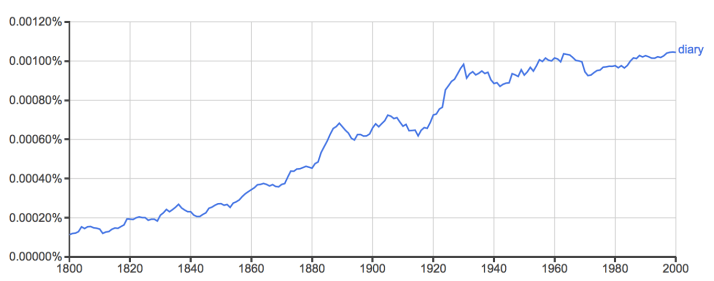
The Google Ngram Viewer yields the following results:

The usage of the word “diary” in print over time:
Screen Shot 2014-10-09 at 9.10.00 PM

The usage of the word “journal” in print over time:

Screen Shot 2014-10-09 at 9.10.54 PM

Insofar as this is reliable data (and I am not sure whether it is*), it would appear that “journal” has had a wider and more consistent usage for a longer period of time, whereas “diary” had followed a track upwards from relatively little appearance in print in 1800 to frequent appearance today. Of course the host of meanings attached to the word “journal” also explains its frequency.

In my own experience, “diary” is a word I long associated with antiquity — something kept with a quill pen — and with girlhood — the pink book with its little key. Neither was an image I could relate to. It was in the 1980s that I started hearing the word “journal” and particularly in the verb form, “to journal” — terms I found engaging. I thought of myself as journaling — I addressed my journal as a journal. It is only recently as I’ve started to study historic diaries that the term “diary” has become a more relevant one. I noticed a shift in my own writing, which is that I now write about my diary as a diary (though not with the “Dear Diary” address). Thinking of myself as participating in a literary tradition with eighteenth- and nineteenth-century women who kept diaries has given me a very different perspective on the diary as a form. But such is the mutability of language that I might again someday think of what I do as “journaling.”

* The Google Ngram Viewer is a great tool for “armchair historians” (as Ben Zimmer writes), but I hesitate to place faith in the Google digital book corpus. Among other things, the privileging of print matter in determining word history is problematic — all the more so if what you are interested in is unpublished or manuscript materials. Does the print history of the word “diary” actually tell us more than the use of the word “diary” in actual — and generally un-digitized — diaries?