Writers and the Writerly Denial of Diary Writing

Screen Shot 2015-02-21 at 11.42.39 AM

When you start to look around for writing about diaries, suddenly it seems to be everywhere.

To wit:

Last weekend, The New York Times Style Magazine* featured three mini-essays by writers on their relationships with diary writing: Sarah Manguso, Amalia Ulman, and Heidi Julavits.

This week, the online teen magazine Rookie** published an essay by Zadie Smith on her decision to not keep a diary.

All four essays are very interesting meditations on diaries but here are my two takeaways:

1. So, there are no male writers with something to say about diaries? The association between the diary genre and women (i.e., it’s a form of private writing, therefore one more likely to be practiced by women) has been theorized, deconstructed, and troubled by several generations of literary critics, yet it has remarkable durability. None of the four authors comments on this — they, rightfully, do not see themselves as speaking on behalf of women writers, or women in general. They do not say that diary-writing is women’s work, because it is not. But, this is news that may not yet have reached the editors of these periodicals. I wonder: has anyone ever asked Jonathan Franzen if he keeps a diary?

2. The other notable theme across the four pieces is that the authors actually don’t keep diaries. This is what I am calling the “denial of diary.” Apparently, it is best to speak of diary writing in the negative: I once kept a diary but I don’t any more. I tried to keep a diary but I simply couldn’t. I briefly kept a diary but not really because it was a fictionalized art performance piece. In some ways this is the most writerly of all the poses these authors adopt: apparently, a writer cannot and should not keep a traditional “this is what happened to me” diary. Somehow that genre is too ordinary for a real writer. A real writer will find a way to cleverly invert the terms of the genre to produce something that is indebted to the diary but ultimately rejects the terms of the diary.

I get it. I am sympathetic to the artistic impulse to push against expectations. But, on behalf of all the traditional diary writers, I am a bit defensive. Really, Zadie Smith? Writing in the first person is disgusting, dishonest, artificial, intolerable, laborious, stressful, and, horror upon horrors!, American? (All adjectives that Smith uses.) On behalf of all the people who put a date at the top of the page and write “Today I,” I would like to protest this string of invectives. Diary writing is not for everyone but can you please explain to me why someone who does not write a diary and finds the practice offensive to her sensibilities is the one who is asked to write about writing a diary?

* While I am in ranting mode, I take this opportunity to also comment on how hardily I dislike the New York Times Style Magazine. I subscribe to the Sunday New York Times and I enjoy it immensely. I like feeling as though I have some purchase on what concerns the cultural elite in our country. For the most part, my enjoyment is undiluted by the fact that the cultural elite are also the class elite — I can read about the museums and plays that rich people attend without getting too fixated on their richness. The Style Magazine makes that more challenging. Nothing like 47 pages devoted to advertisements for designer handbags and articles on how $10,000 shirt dresses are the latest thing to put the class status of the New York Times audience front and center. This context probably colors my reading of the essays by Manguso, Ulman, and Julavits: they may not be members of the literary upper-class but appearing within the pages of The Style Magazine makes them appear that they are — which makes me suspicious of their self-deprecating self-representations. Somehow The Style Magazine makes the diary appear simultaneously trendy and passé: something that trend-setters are doing, but only doing with a pretentious twist. Almost makes me want pull a Zadie Smith.

** Rookie actually has an on-going diary column in which five teen girls publish their diary entries in the magazine, as well as several previously published essays about diaries including a wonderful archive featuring pages from their readers’ private diaries. So, I do feel a bit guilty about lumping this periodical into the same class as The New York Style Magazine. They are very, very different publications and the brilliant Zadie Smith can do and say whatever she wants!

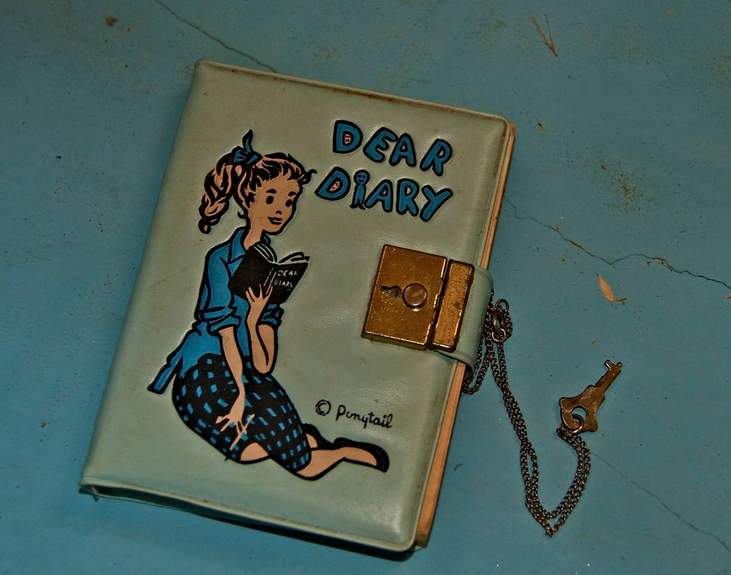
Photo Credit: Pushing Time

Book Review: Annihilation by Jeff Vandermeer

Diary Index Book Reviews focus on the role and representation of diaries or journals in contemporary fiction. Warning: may contain spoilers.

Annihilation by Jeff Vandermeer (Farrar, Straus & Giroux, 2014)

Vandermeer’s Annihilation is a surreal but fascinating story about a team of scientists sent to explore a mysterious place that challenges all of their techniques of analysis and meaning-making. It is also a diary novel. Vandermeer employs a first person, retrospective narrative voice — the voice of a survivor or, in this case, the only survivor of the expedition. A few pages into the novel, we learn that we have access to this voice because are reading the narrator’s journal. It is a smart move: the narrator — who is known simply as “the biologist” — is compromised early in the novel when she is infected by an unknown spore, so her perception is suspect from the beginning; she is a quintessential “unreliable narrator.” Of course, in this novel, the notion of perception and particularly of reliable scientific knowledge is always under question. The journal structure of the novel allows us entry into the mind of this character and provides an explanation and justification for the fact that a narrative exists at all, while nonetheless playing upon the conventions of the genre: its deep interiority, lack of referentiality, and, yes, unreliablility.

The place the team is sent to investigate is known as Area X and its origins, boundaries, and purpose are represented as a mystery that eleven previous expeditions have attempted to decode, but unsuccessfully and with disaterous and deadly consequences. The teams are not allowed to take highly technological tools — certainly nothing involving digital or computer technology — and, as result, their experiences are to be recorded in journals which Vandermeer describes as “lightweight but nearly indestructible, with waterproof paper, a flexible black-and-white cover, and the blue horizontal lines for writing and the red line to the left to mark the margin” (8). As a manuscript geek, I love this attention to detail. Vandermeer places the biologist’s journal in the hands of the reader — we are to imagine that we are reading her handwritten account: “It was expected simply that we would keep a record, like this one, in a journal, like this one …” (8). The “one” referred to here is the book that the reader holds in her hands. But, are we reading a personal diary or a scientific record? The novel oscillates back and forth between these two roles of the journal: the biologist reveals portions of her past, her motives, and her memories — she also records her observations, questions, and theories about the strange sights she encounters. This use of the diary as scientific record evokes for me the history of early botanists and naturalists whose field journals served as fodder for their scientific writing — Darwin’s Beagle journal comes to mind. Vandermeer’s biologist is engaged in a similar effort to make sense of the world without recourse to the modern tools of analysis; the written word becomes her method, though it has a dubious value within the unstable terrain of perception depicted within the novel.

In addition to writing her own journal, the biologist encounters other explorers’ journals. In a pivotal scene, the biologist discovers a stash of journals, what she describes as “a kind of insane midden” (106): “a pile of papers with hundreds of journals on top of it — just like the ones we had been issued to record our observations of Area X. Each with a job title written on the front. Each, as it turns out, filled with writing. Many, many more than could possibly have been filed by only twelve expeditions.” This discovery causes the biologist to realize that Southern Reach (the quasi-governmental body that manages the investigation of Area X) has not provided complete and accurate information about previous expeditions and therefore none of the information Southern Reach provided can be considered complete and accurate. Evidence of so many hundreds of failed expeditions also indicates that the level of danger was much higher than she previously understood; the likelihood of survival is, at this point, revealed to be slim. But beyond these realizations, there is something particularly horrific about the spectacle of the pile of journals that, I believe, hinges upon the journal or diary genre itself. When the biologist is handed her black-and-white journal by a Southern Reach official, it is implied that her experience has significance and that it will become part of the growing body of knowledge on Area X. In other words, it will be read. But, the pile of abandoned journals suggests the opposite: her experience doesn’t have value, her journal will not be read, it will end up on a pile of decomposing trash. There is something so poignant about so many life stories left to molder — it echoes for me the existential anxiety of diary writing itself: Why keep a diary? Who will read it? Does the author’s life has value? The biologist calls the journals “flimsy gravestones” (110), the devalued markers of all the lives lost in Area X, but she could speak of diaries more generally: paper gravestones, always in danger of going unread and unappreciated.

At this moment, the biologist becomes not just the author of a journal but a journal reader, as well. She salvages several journals from the pile, including her husband’s (he had gone to Area X on the previous expedition). Yet she finds reading her husband’s journal difficult: “I had to resist the need to throw the journal away from me as if it were poison … He had meant to share this journal with me, and now he was either truly dead or existed in a state beyond any possible way for me to communicate with him, to reciprocate” (161). This statement — the biologist’s visceral recoil from her husband’s journal — is a wonderful encapsulation of what it is like to read another person’s diary. In my experience, it is almost impossible to not become overwhelmed by the absence of the author. Somehow, it is possible to read published books by deceased authors without sparing a thought to the fact that the author is dead but when you read a diary, the author’s absence — and the inability of the reader to cross the bridge and connect with the author, even as you read his or her intimate thoughts — is profound and sometimes paralyzing.

I have only read the first volume of Vandermeer’s Southern Reach trilogy so I don’t know whether the journal format continues into the next two volumes. Certainly I hope that we haven’t heard the last from the biologist — though, given what I’ve seen in this first book, I don’t hold out hope that we will find the biologist reunited with her husband and living a quiet and still-human life on the island. Annihilation is equal parts beautiful and terrifying, and I believe that a great deal of its accomplishment depends upon the diary structure, which Vandermeer deploys with skill and insight.

Archiving the Modern Diary

What is the best way to preserve a diary for later readers? It’s a question I think about a great deal. As a scholar who works on historic diaries, I am painfully aware that the materials that I study only exist because someone along the way — a family member, an archivist, a librarian — decided that, rather than throw a diary in the trash, it was worth keeping. When I want to make myself crazy, I think about all the diaries (and other paper ephemera) that weren’t preserved but which found their way into middens, garbage heaps, or fireplaces … decaying into compost or flying up the chimney in the form of ash, and the author’s voice lost forever.

This isn’t just a question relevant to historic diaries, but to modern diaries and journals as well. If you are a diarist, what will happen to your diary after you die? Have you made arrangements? If you are in possession of someone else’s diary, what are you going to do with it? I plan to post some guidelines here for diary preservation and donation (I’m working on those now) but in the meanwhile, I want to introduce two really remarkable efforts to collect and preserve modern diaries:

The National Diary Archive Foundation (link to Italian language site) in Prieve Santo Stefano in Tuscany, Italy collects diaries, memoirs, and letters written by ordinary people and is reported to have over 7,000 items in its collection. The Foundation has an open donation policy — diary authors can simply send their diaries to archive — as well as an annual contest; diary authors can submit their work to be reviewed by a panel of readers that selects the Premio Prieve Saverio Tutino winner. From what I can tell, the Foundation appears to primarily collect materials by Italians — though their donation practices suggests the archive could ultimately end up with a large, multinational collection.

The Great Diary Project is a similar effort based in the UK. As the website states, “The work of the Great Diary Project is to rescue diaries like these from skips and bonfires and look after them for the future as important items of everyone’s history.” The collection now contains 2,000 items. The GDP Deposit Form does an excellent job of guiding the submission process: for example, you have the option of embargoing the diary for a few years, in order to assuage concerns about privacy. The GDP is affiliated with Bishopsgate Institute in London, which is a significant detail in my opinion; the GDP’s connection with a institution of higher education with a public library means that the collection has a greater chance for survival — and of remaining an open, accessible archive for scholars and readers.

To the best of my knowledge, there is no equivalent effort underway in the United States to collect and preserve diaries. Needless to say, I think there should be. Local libraries and historical organizations are obvious sites for donating diaries, but they are governed by their own individual concerns about space, subject matter, accessibility, and so forth. In other words, I don’t think you can always count on a local library or historical organization to accept and accurately preserve a diary. Ideally, there would a specialized archive with an open submission policy to guarantee that the voices of ordinary Americans were saved from obscurity. If I had a million dollars, I would found and fund such an organization but, in light of the fact that I don’t, I call upon librarians, scholars, and diary authors to advocate for the creation of such an archive. Imagine it! The Great American Diary Archive. The press release positively writes itself.

Reading a Diary into Evidence

Screen Shot 2015-01-24 at 6.52.19 AM

I’m listening to Serial — arriving late to this strange new media phenomenon — and in Episode 2 a diary appears: the young woman who was murdered, Hae Men Lee, kept a diary and it is read into evidence at the trial against Adnan Syed.

Which got me thinking about diaries as evidence in legal cases.

I have to admit that is one of my fears — one of the two main reasons that I consider destroying my own diaries: that something will happen that will result in my diaries being taken away by police investigators and read by them as they attempt to solve a crime. It really doesn’t matter what the crime is — whether I am being investigated or whether I am the victim — either way, I do not want my diaries read in this context. (The other reason, in case you’re wondering, is the polar opposite scenario, one in which people closely related to me read my diaries — like my parents or siblings. Ugh.)

Listening to Hae’s diary being read in the taped transcript of the trial I thought, really? This really counts as legitimate evidence in a murder trial? I’ve written before about the trope of the discovered diary in mystery novels and how it’s such a cliché that most authors wouldn’t dream of deploying it straight. Who is going to believe that a diary provides the clues necessary to solve a crime?* Listening to a non-fictional instance in which that — or something close that — actually occurred was eye-opening for me. Hae’s diary is no “smoking gun,” pointing a finger directly at Adnan as her killer. Instead, it’s used in the trial (as far as I could tell) to establish the character of their relationship, that the end of the relationship had caused emotional pain but that Hae had moved on to her new boyfriend — contributing to the prosecution’s case regarding Adnan’s motive.

And the phone number, of course. Hae writes Adnan’s new phone number in her diary, proof that he called her the night before. That bit of marginalia is completely fascinating from a textual studies point of view, demonstrating how diaries can be used for numerous, unpredictable, spontaneous, and revelatory purposes.

But: does the diary actually bear the weight of evidence?

Diaries are generally unreliable, unstable, piecemeal, deeply interior texts. They provide only a glimpse of a portion of a constructed version of the diarist’s life. When I think of how much my own diary leaves out, all the things that happen in my life that don’t make it onto the pages of my diary because I am too busy to write or they appear insignificant … well, suffice to say that my diary is no accurate representation of my state of mind, my relationships, or the kinds of incidents that could serve as clues in an investigation.

As a literary critic, the incompleteness, unreliability, and interiority of a diary are not a problem. The tools of literary analysis enable us to identify these issues and investigate their meaning. Literary critics are not looking for “truth” (what really happened) or “motive” (why did X do what s/he did) or “timeline” (when did X happen). We are looking for voice, structure, construction of identity, language use, representations of time and space — the kinds of things that make diaries rich for textual analysis but poor for legal evidence.

Nevertheless, including Hae’s diary in the trial seems like a smart move on the part of the prosecutors. They have one of Hae’s friends read the diary in the courtroom, a young woman of roughly the same age as Hae, and this seems to me like an effective way of engaging the jury’s sympathies. It gives Hae a voice — and, because the diary is thought to communicate something true and authentic, it probably comes across as an expression of Hae’s deepest inner self. Essentially, the prosecutors leverage cultural assumptions about diaries to make the jury feel connected to Hae and therefore eager to punish her murderer.**

One final detail that really caught my attention: During the trial, it appears that copies of the diary circulated pretty widely as both the prosecution and defense sought to build their cases. But what weirded me out was that Adnan had read it too. It’s not clear when or why or how it came into his possession but … what the hell? I haven’t finished Serial yet and so far I waffle back and forth on the question of Adnan’s innocence or guilt but the idea that Hae’s (possible) murderer was reading her diary … was given access to her diary … that troubles me. She was violated in so many ways — some people think that Serial is violating her again — but the idea of her (possible) murderer reading her silly, messy, charming, personal diary strikes me as yet another violation.

* Of course, then I spend some time googling “diary” and “testimony” and run across stories like this one, in which a woman documents her plan to murder her children and then describes the experience of murdering them. In her diary.

** My discussion of Hae’s diary is from the perspective of a literary critic, but I found a great analysis of the issue by lawyer Collin Miller, from whom I learned that Hae’s diary is considered a form a “hearsay” and, as such, should not have been admissible in the trial. Miller believes that Adnan’s lawyer failed to prevent the diary from being included, which was yet another way in which she failed to build a good defense for her client. Miller also points out that had Adnan kept a diary, it would have been admissible as evidence — either as proof of his motive or as defense against it. It’s an intriguing idea: If Adnan had also kept a diary it could have implicated him — or maybe freed him.

Guantánomo Diary

In 2005, Mohamedou Ould Slahi wrote a 466-page, 122,000 word diary describing his detention in Guantánomo. He remains imprisoned there today. Amazingly, in 2012, his lawyers succeeded in declassifying the document. His Guantánomo Diary is now available in bookstores.

For more on how the diary came to be published, The Guardian‘s “Guantánamo Diary: How a classified, handwritten manuscript became an extraordinary book”

To read an excerpt, or to hear Stephen Fry read it to you, also from The Guardian:
“Guantánamo Diary: ‘They made me drink salt water. The chains stopped the circulation to my hands and feet'”

UPDATED LINKS:

The Guantánomo Diary houses a rich archive of materials:

  • a partially animated documentary explaining Mohamedou Ould Slahi’s case.
  • a link to the entire handwritten manuscript, including redactions
  • a series of audio recordings of celebrities reading from the text.

The New York Times Jan 20. 2015: “Family Seeks Release of a Guantánamo Detainee Turned Author”

The American Civil Liberties Union: “Guantánamo Diary: An Epic for Our Times” and a call to action to sign the ACLU-led petition to Free Slahi.

CFP: “Materialities of American Texts and Visual Cultures”

Conference Dates: April 9 & 10, 2015
Deadline for Proposals: January 23, 2015

Hosted by: Columbia University’s Department of Art History and Archaeology and Rare Book and Manuscript Library, New York, NY. Co-Sponsored by the Andrew W. Mellon Fellowship of Scholars in Critical Bibliography at Rare Book School, the Bibliographical Society of America, and the American Print History Association.

Organized by: John Garcia (jgar@berkeley.edu) and Marie Stephanie Delamaire (mmd2108@caa.columbia.edu)

On April 9-10, 2015, curators, conservators, and scholars from various disciplines will convene at Columbia University to discuss new approaches to American print and visual cultures generated by the recent humanistic interest in materiality.

From current historical work on material and visual cultures, to anthropological research on the social life of things and new approaches to reading and interpretation in historical scholarship, the study of the physical evidence of culture has become a pressing issue. This interdisciplinary symposium will bring together curators, conservators, and scholars of art history, literary studies, book history, and bibliography to discuss common questions and disciplinary challenges in the study of texts and visual cultures produced in the United States during the long nineteenth century. This period witnessed concomitant transformations in book and image production methods as well as in publishing practices and distribution networks that affected every aspect of American society and culture, including the emergence of early African American literary traditions and printed American Indian texts and images. Additionally, the emergence of a mass production of images was largely interwoven with new forms of literary productions such as illustrated novels, and serial publications. Both print and visual cultures were largely built upon practices of reprinting, recycling, and inter-media translation, where the relationships between user and maker, as well as between texts and images were constantly re-negotiated. But how we move from reckoning with these transformations towards making more compelling humanistic interpretations remains an open question. For both literary studies and art history, concerns with materiality interweave familiar interpretive issues of aesthetic, formal, and narrative complexity with the questions of format, presentation, and modes of production and transmission that have long concerned bibliographers and historians of material texts.

To stimulate discussions, and foster productive scholarship crossing between literary, material, and art historical studies, we seek proposals for 20-minute presentations exploring the historical relationships between the materiality of nineteenth-century American printed texts and images.

Materials to be considered might include but are not limited to: illustrated books, periodicals and newspapers, gift books, publishers’ archives, lottery tickets and rewards of merit, scrapbooks, early artist’s books, broadsides and other ephemera, cartography, political cartoons, manuscript cultures, drawing and handwriting in the era of mass print.

Topics and approaches from presenters might include but are not limited to: Redefining the relationships between technology and creative practices, inter-medial translation, cultures of reprinting, embodiment and studies of readers and reading, the temporal and spatial dimensions of images and texts, historicism(s) past and present, economies of scale, distributive processes in the movements of images and texts, the production and subversion of identity and social norms, the material texts and visual cultures of abolition, social movements, and marginalized communities.

Committed speakers include: Jennifer Greenhill (Urbana-Champaign), Elizabeth Hutchinson (Barnard/Columbia), Michael Leja (Penn), Christopher Lukasik (Purdue), Todd Pattison (Rare Book School), Jennifer Roberts (Harvard), Phillip Round (Iowa).

In order to be considered, please Submit proposals for participation by Friday, January 23, 2015 to: 
Marie-Stéphanie Delamaire (mmd2108@caa.columbia.edu) and John Garcia (jgar@berkeley.edu).
Proposals should include:

 1. Preliminary abstract (no more than 500 words).
 2. Letter explaining speaker’s interest and expertise in the topic. 3. A brief 2-page CV with email address. Notifications will be sent by Monday February 23, 2015.

Diary and Diary Fiction at MLA 2015

I’ve been deep in diary research the past few weeks as I prepare a talk for MLA 2015. I organized a panel on diaries and diary fiction, and was gratified by the large number of excellent proposals I received. My fellow presenters represent a variety of critical approaches to the study of diary and diary fiction, as well as different national literary traditions and time periods. I cannot wait to hear their papers.

My own talk is a bit of a stretch for me. Here’s how it came to be:

Me (in my pajamas, reading the New York Times Book Review on a Sunday morning, circa 2013): Huh. There’s another review of another novel that prominently features a diary. Isn’t that strange? (Adds book title to growing list.) I wonder why so many contemporary novelists are relying on the diary? What does it mean? Maybe I could write a paper about this?

Well, a few years later and I’ve been reading contemporary diary fiction and hopefully by Sunday I’ll have something productive to say about a selection of these novels. I will be talking about:

Gillian Flynn, Gone Girl (2012)
Tim Parks, Sex is Forbidden (2012)
Scott Hutchins, A Working Theory of Love (2012)
Ruth Ozeki, A Tale for the Time Being (2013)
Stephen Lloyd Jones, The String Diaries (2014)

One of the questions I am considering is why, although each of these novels is set in the present, none of the diary writers keeps their diaries on a computer or blog or any other digital format. While I myself am dedicated to my handwritten diary and cannot imagine typing my diary onto a screen, the common theme across the five books of eschewing available technology in favor of the old fashioned manuscript diary really interests me. I have some theories about why this is and how it impacts each novels’ representation of a diverse range of media and technologies.

Something I’ve learned working on the talk: it’s very hard to discuss five novels in 15 minutes. Hopefully the audience will be understanding about my thumbnail analysis.

Here’s the line up …

Screen Shot 2015-01-05 at 7.53.03 PM

Vancouver, here we come!

The Discovered Diary Trope

Warning: Contains mild spoilers regarding Tana French’s In the Woods.

Screen Shot 2014-11-30 at 1.42.36 PMI was recently reading Tana French’s bone-chilling novel, In the Woods. If you haven’t read it, drop everything and do so immediately. It won’t take you long because it is one of those un-put-down-able, stay-up-to-3am mysteries. Late in the novel, the protagonist/detective finds the diary of the young woman whose murder he has been investigating, which made me think about that old chestnut, “the discovered diary trope.” You know it: a diary is discovered that contains crucial information that allows mysteries to be solved or truths to be revealed. I would characterize it as tired, overused, and narratively lazy trope, one that good writers steer away from.

I’m reminded of a wonderful work of short fiction from the middle of the nineteenth-century, Annie Frost’s “My Experience,” published in 1867 in Godey’s Lady’s Book. The story lambasts the stale conventions of romantic fiction of that era (which aren’t all that different from the stale conventions of contemporary romantic fiction). The narrator is an author who sets out to write her first novel, stocking it full of all the familiar formulas of her selected genre: “My plot was continually tangled into double knots and intricate twists, to be nicely drawn out and wound off in even threads, till every horrible mystery lay coiled in a nice little ball of explanation at the end.”

Here’s my favorite part, when the narrator describes one of the particular challenges with which she confounds her characters:

Heir to a princely fortune, [the male love interest] lives in a garret upon a crust, because his rich uncle’s will, instead of being filed at the lawyer’s, is tucked away in an old-fashioned writing-desk, containing unsuspected drawers. (I wonder it never occurs to heroes and heroines, under these circumstances, to smash all the furniture in the house — it is almost certain to pay.)

I love that parenthetical aside and the image it conjures up of characters across literary history willy-nilly smashing furniture in search of hidden wills that will turn their circumstances from poverty and hardship into wealth and opportunity.

Although Frost speaks here of hidden wills (c.f. the Trope of the Hidden Will), it shares some similarities with the Trope of the Discovered Diary. The discovered diary trope has several embedded presumptions about diaries:

  1. Diaries contain useful information.
  2. Diaries reveal the truth about the authors’ relationships, goals, thoughts, and values.
  3. Diaries solve mysteries.

Of course, diaries generally don’t contain what might be considered useful or truthful information — in the sense of authentically characterizing either the author or her subject matter. Diaries are generally so idiosyncratic, interior, and fragmented that their readers are forced to speculate about their real meaning. (This is what so much diary scholarship boils down to.) It’s hard to imagine an real diary containing a statement such as “If I am murdered, my killer is _____.” (Though I am tempted to write such a sentence in my own journal now.)

Discovered diaries need not be formulaic pap. In the hands of someone like French, the discovered diary trope becomes something else. In In the Woods, French turns the trope on its head (as she does throughout the novel with regards to multiple mystery/detective fiction tropes): the diary is not discovered by the detective but someone else, who hands it over to him; the diary doesn’t solve the mystery (it’s already been solved); and the diary does not guarantee that the guilty party is caught or punished (she isn’t). French’s discovered diary frustrates expectations by failing to provide resolution. In that sense, it is a wonderful citation of the trope, even as it subverts it.

EDITED to add: I’ve been reviewing my notes on diary criticism and stumbled across Abbott’s discussion of the “conceit of the found object” and the common framing device of representing a diary as a real document that is found and introduced by another. While not exactly synonymous with “discovered diary trope” I’ve addressed here, it’s still worth citing this useful source: H. Porter Abbott, Diary Fiction: Writing as Action (1984).

How To: Diary Advice Then & Now

One of the fascinating themes in popular writing about diaries is advice on how to write a diary/journal. You can find a host of contemporary advice books on diaries — and I hope to write about them here someday. But, it is by no means a new phenomenon.

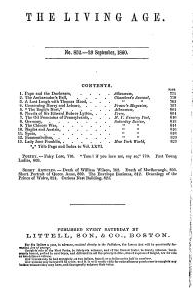
Screen Shot 2014-11-23 at 5.36.08 PM In 1860, under the title “Concerning Hurry and Leisure” the popular periodical The Living Age republished an essay that was originally published in a British magazine (following the common practice of poaching from European periodicals). The article begins by advocating keeping a diary through a memorable image: “If a man keeps no diary, the path crumbles away behind him as his feet leave it; and days gone are but little more than a blank, broken by a few distorted shadows.” After providing specific suggestions for how to write a diary (“A few lines, a few words, written at the time, suffice …”), the author continues to make his case for the rewards of diary writing:

There must be a richness about the life of a person who keeps a diary, unknown to other men … Life, to him looking back, is not a bare line, stringing together his personal identity; it is surrounded, intertwined, entangled, with thousands and thousands of slight incidents, which give it a beauty, kindliness, reality.

It is not merely a collection, an aggregate of facts, that comes back; it is something far more excellent than that; — it is the soul of a few days ago; it is the dear Auld lang syne itself!

These ideas are familiar, I think, recycling the old adage that reflecting upon one’s life gives that life more meaning. The diary is the tool for this self-reflection and memory-preservation.

Screen Shot 2014-11-23 at 6.12.54 PM

Compare this with a much more recent incarnation of the “diary advice” genre: Blogger Karen Walrond posted a wonderful version of this on the blog Lime. In her “A new way to think about journaling: a primer,” Walrond lays out her own journaling practices and encourages readers to adopt them. What makes Walrond’s journaling practices innovative is that she advocates breaking away from the conventional “diary as daily reflection” model and instead using one’s diary for a variety of purposes: as a to-do list, for “morning pages,” as a scrapbook or photo album, as a place for artistic expression, etc. Walrond’s language is, however, as promotional as the 1860s piece above:

… capturing your messy, imperfect life, with no thought about how you want the final product to look or read — the result, of course, is that you’ll have an accidentally beautiful record of your life and times.

Although Walrond’s method is different, the spirit of these advice columns remains pretty consistent: diary/journal writing is a personally transformative experience. Whether the promise is to result in a perfect recreation of one’s life (as stated in 1860) or to honor the messy imperfection of one’s life (in 2014), both authors promote the diary as the ideal mechanism for gaining a new relationship to existence.