Mass Observation Diary Day

Screen Shot 2015-05-16 at 8.49.28 AMDid you miss Mass Observation Diary Day on May 12?

Here’s the history: In 1937, on the day of George VI’s Coronation, a Mass Observation Day was held across the UK, with citizens invited to record their daily experiences. The result was the Mass Observation Archive, which ran an annual observation day on May 12 until the 1950s. It was revived in the 1980s by the University of Sussex.

This year’s Mass Observation Diary Day was enhanced by social media: an invitation to submit diaries via email or to upload digital photographs, the Twitter hashtag #12May15, a Facebook page, and a resulting Storify page.

The archive collected over these many years is open to scholars, and I can think of so many ways that it will enhance our understanding of the everyday lives of ordinary people. Bravo!

Diary Story: “Never More than 60 Hours without a Diary Entry”

Richard Grayson is a writer, political activist, and performance artist. He is the author of With Hitler in New York (1979), I Brake for Delmore Schwartz (1983), The Silicon Valley Diet (2000), and other short story collections. In 2004, Grayson authored a column for McSweeney’s documenting his satirical run for Congress, “Diary of a Congressional Candidate in Florida’s Fourth Congressional District.” The online magazine Thought Catalog is currently reprinting Grayson’s early diary entries. He is a self-described graphomaniac, with a daily diary-writing practice for almost fifty years.

1. When did you start keeping a diary or journal? What prompted you to do so?

I was 18 years old in August 1969. I’d spent most of the previous year in my room because of my agoraphobia. As a kid, I began getting what we would now call panic disorder; it intensified in my teenage years to the point where I asked my parents if I could see a psychiatrist, and although the doctor was probably a good psychoanalyst, I just got worse and worse, with panic attacks getting more and more frequent, and I eventually began to fear leaving the house, so I didn’t start college when I was supposed to. Eventually I got so bad that the doctor gave into ­­my mother’s demand that I be given some sort of medicine. The prescription, a combination antipsychotic tranquilizer and tricyclic antidepressant, began to work in a few weeks, and as spring came, I was able to go out more and more, still getting panic attacks but being more able to deal with them. It was the summer of 1969, a pretty exciting time culturally, especially in New York City, and I felt as if I were reborn; on Friday, August 8, 1969, I was passing a bookstore near Brooklyn College and saw this 1969 diary on sale for half-price. It was a hardbound red book, the size of a regular book, and I felt compelled to buy it, and right after I bought it, I sat down on the grass on campus and wrote the first eight entries for August, as if I’d started writing the week before. And I just kept writing every day for the rest of my life.

2. How often do you write in your diary or journal?

Almost every day. I never let a day go by without an entry. The diary has one page per calendar day. As I got older, there would be times when I knew I’d miss a day, like a drive from New York to Florida or back, or I knew I’d stay over at someone’s house and didn’t want to take the diary, so I’d write a little in advance sometimes or the next day. I’ve never gone more than about 60 hours without writing a diary entry. I am compulsive and I am somewhat of a graphomaniac.

3. Have there ever been periods of time when you ceased to write in your diary or journal? If so, why?

No.

4. Describe the physical form of your diary or journal: handwritten or typed? notebook or laptop? etc.

It’s the same diary book. It’s gone through four or five changes of ownership of the company, but it’s geared toward businesses, and it’s a “standard” diary, so it’s always had the same “number” – 55-148 – no matter which company manufactured it. I write in longhand with a black pen (sometimes I’ve used a blue pen). I need to write more than the lines I’m given, so starting in about 1972, I began writing a microscript, using two lines of my writing for each line of the lines in the physical diary. My handwriting, once beautiful, is now illegible; I often can’t immediately make out the words the day after I write them. I should probably switch to a digital diary, but I don’t want to lose the connection with the past, and it’s the writing of the diary that’s important to me, not deciphering my elderly handwriting.

5. What do you write about in your diary or journal?

My day’s events; ideas for stories or other projects; sometimes, reactions to news events or things I’ve read; I’ve quoted parts of reviews I’ve gotten or newspaper articles about me; pretty much whatever comes to my mind, although it’s always in full sentences with subjects and predicates. I don’t like the “Had dinner with Jim”-type fragments in diaries. If I quote conversations, I do it the way I do it in fiction.

6. Have you ever or would you allow someone else to read your diary or journal? Is privacy an important aspect of your diary or journal writing?

I’ve published large excerpts of my diaries on websites and print-on-demand self-published books and e-books, but so far I’ve kept from publishing anything since 1998 entries. If I’m able, I’ll do that, but I probably wouldn’t show anyone stuff from the previous few years. I change most people’s names when I publish them, but not all. I don’t care about privacy.

7. Have you ever read someone else’s diary, published or unpublished?

I’ve read authors’ diaries, like Virginia Woolf’s (and her husband Leonard’s). Samuel Pepys, of course. The usual famous diaries, I guess, like those of Harold Nicolson, Anais Nin, Ned Rorem, and Donald Vining’s A Gay Diary. I met Donald Vining at a small press book fair and had a wonderful talk with him about diary-keeping.

I don’t think I’ve ever read anyone else’s diaries. One summer I was staying at the home of my friend’s parents while they were away – I later lived in that house for years – and I found my friend’s mother’s diary by accident. Once I realized what it was, I put it away without reading it. I would not want to read the diaries of anyone else in my life, and most people in my life don’t want to read my diary.

8. Has social media changed your diary writing practices, or changed how you think about your diary? If you use social media, how does your writing in digital formats compare to your diary or journal?

Social media – in particular, a blog I kept – changed the way I would describe events I went to. My blog was about the concerts, plays, lectures, art openings, readings, political rallies, street fairs and other New York events I’d attend. I’d usually write the blog entry when I got home, and my own diary entries about the event were much shorter and less detailed. Since I never used social media to write about my work or personal life, that has stayed the same.

9. How often, if ever, do you read through your previous diary or journal entries? Have you ever edited, redacted, or destroyed any parts of your diary or journal? Why?

Very often, because I’ve been transcribing them from handwriting into digital form for publication. Now I continually read old entries as I publish them more or less constantly. I proofread, correct errors, and make occasional mechanical and structural changes; at 18 or 19, I tended use a dash when I needed a semicolon or colon. I don’t read diaries I’m not transcribing or publishing unless I am trying to remember something in particular.

I’ve edited lightly, as I explained above, for publication. I’ve left out very few things, and all of them pertained to secrets of other people that I would not want to reveal, that it is not my place to reveal. For example, if I know that someone’s father is not really that person’s biological father and that person doesn’t know it, I am obviously not going to let anyone see that because it’s messing with people’s lives, something only a monster would do. For myself, I don’t censor much of anything – usually extremely mean things I’ve said at the heat of the moment. I would censor things that hurt other people. I would never destroy my writings. No one really cares, anyway.

10. What do you plan to do with your diary or journal in the event of your death?

At one point, I tried to see if I could donate the now-46 volumes to a library – my first choice would be the Brooklyn College Library or some other academic library from the other two dozen or so colleges and universities where I worked, or the Brooklyn Public Library – but no one seemed interested. So I guess I will just let whoever survives me (I have no children, no nephews or nieces, so my estate would probably either go to a distant relation I don’t know or escheat to the state I died in) deal with them. I’ll be dead, so who cares, really? Anyway, a lot of it is available online or in ebook/book form if they still exist when I’m dead.

The origins of the Diary Story in 10 Questions is described here. If you are interested in sharing your story, please contact me.

Diary Stories in 10 Questions

Screen Shot 2015-05-04 at 5.19.10 PM

I’m looking for volunteers. Would you be interested in telling your diary story?

One of my goals for this blog has been to gather information from fellow diary enthusiasts. It is very hard to know what diary and journal writing means today — hard to develop a sufficient corpus of data to draw meaningful conclusions about who writes a diary and what they write about. The French scholar Phillippe Lejeune faced this problem early on and employed an innovative research method: he posted a newspaper ad, asking individuals to complete a questionnaire he developed.* Initially, I thought I would try to replicate his method here, using social media to gain access to a larger number of people than Lejeune was able to through the newspaper, but I’m daunted by my lack of both technical and statistical knowledge. I simply don’t know enough to gather or analyze that kind of data. But I do know how to think about stories, so that’s what I propose to gather: people’s individual accounts of their diaries, their diary stories.

These are the 10 questions I’ve developed. What do you think? Are they sufficiently thought-provoking? Do they answer the questions you want to know about people’s diary-keeping habits? Are they overly technical? (I’m worried that they are overly technical and display my scholarly geekery to its fullest.) And, most importantly, would you be willing to answer these questions here?

Diary Stories: 10 Questions

  1. When did you start keeping a diary or journal? What prompted you to do so?
  1. How often do you write in your diary or journal?
  1. Have there ever been periods of time when you ceased to write in your diary or journal? If so, why?
  1. Describe the physical form of your diary or journal: handwritten or typed? notebook or laptop? etc.
  1. What do you write about in your diary or journal?
  1. Have you ever or would you allow someone else to read your diary or journal? Is privacy an important aspect of your diary or journal writing?
  1. Have you ever read someone else’s diary, published or unpublished?
  1. Has social media changed your diary writing practices, or changed how you think about your diary? If you use social media, how does your writing in digital formats compare to your diary or journal?
  1. How often, if ever, do you read through your previous diary or journal entries? Have you ever edited, redacted, or destroyed any parts of your diary or journal? Why?
  1. What do you plan to do with your diary or journal in the event of your death?

* See Lejeune, On Diary. Eds. Jeremy D. Popkin and Julie Rak. Trans. Katherine Durnin. Manoa, HI: U Hawaii P, 2009. I wrote the questions above without consulting Lejeune’s questionnaire but, upon comparison, they have many similarities — which is not surprising, given our shared interests.

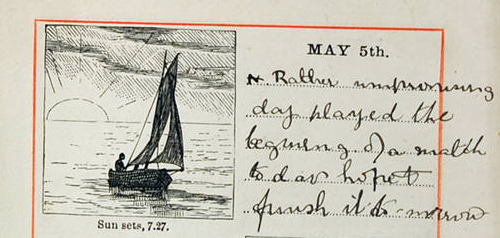
Image source: Ernest Leech’s childhood diary via Chetham’s Library (detail)

Larkin, “Forget What Did”

Stopping the diary

Was a stun to memory,

Was a blank starting,


One no longer cicatrized

By such words, such actions

As bleakened waking.


I wanted them over,

Hurried to burial

And looked back on


Like the wars and winters

Missing behind the windows

Of an opaque childhood.
 

And the empty pages?

Should they ever be filled

Let it be with observed


Celestial recurrences,

The day the flowers come,

And when the birds go.


Source: The Norton Anthology of Modern and Contemporary Poetry. Vol. 2. Eds., Jahan Ramazani, Richard Ellmann, and Robert O’Clair. 3rd Edition. NY: Norton, 2003.

Secret Political Diaries Do Not Stay Secret

This week in diary news teaches us an important fact, crucial for any aspiring politicians: secret diaries disclosing your private opinions about your fellow politicians have an amazing way of not staying secret.

I’ve written before about Dale Bumpers’ diary, which displayed his critical assessment of then political allies, Bill and Hillary Clinton.

This week, Richard C. Holbrooke is in the news thanks to a forthcoming documentary that reveals that the diplomat kept a “secret audio diary” about his frustrations with the Obama administration.

But it’s not only a bad week for secret political diaries in the United States. Canadian Senator Mike Duffy’s daily journal reveals his close ties to corporate lobbying, possibly illegal. It doesn’t help Duffy’s case that his diary writing style also opens him up to ridicule: writing of himself in the 3rd person and puffing himself up with self-praising admonitions like “TS up & at ’em!” Oh dear.

So, open message to politicians: If you are going to keep a diary, and you probably are because you undoubtedly aspire to write a biography soon after you leave office, just be aware that secrecy is an unstable, unreliable concept and it’s very likely that your scathing opinions and petty self-promotions will be discovered and put on full display in the press.

“My Father’s Diary” by Sharon Olds

It is the dark pit of the semester when it seems like the grading will never end. For every assignment you grade and return, two are turned in, an endless cycle that grinds everyone down: student and teacher alike. As a result, I don’t have the time or energy to write here about any of things I’d like to write about: my experience presenting on “digitized diaries” at the Texas Digital Humanities Conference, or two recent diary-related publications that I’d like to review, or anything else. But here’s a beautiful diary poem to tide you over.

Sharon Olds, “My Father’s Diary”

I get into bed with it, and spring
the scarab legs of its locks. Inside,
the stacked, shy wealth of his print—
he could not write in script, so the pages
are sturdy with the beamwork of printedness,
WENT TO LOOK AT A CAR, DAD
IN A GOOD MOOD AT DINNER, WENT
TO TRY OUT SOME NEW TENNIS RACQUETS,
LUNCH WITH MOM, life of ease—
except when he spun his father’s DeSoto on the
ice, and a young tree whirled up to the
hood, throwing up her arms—until
LOIS. PLAYED TENNIS, WITH LOIS,
LUNCH WITH MOM AND LOIS, LOIS
LIKED THE CAR, DRIVING WITH LOIS,
LONG DRIVE WITH LOIS. And then,
LOIS! I CAN’T BELIEVE IT! SHE IS SO
GOOD, SO SWEET, SO GENEROUS, I HAVE
NEVER, WHAT HAVE I EVER DONE
TO DESERVE SUCH A GIRL? Between the dark
legs of the capitals, moonlight, soft
tines of the printed letter gentled
apart, nectar drawn from serif, the
self of the grown boy pouring
out, the heart’s charge, the fresh
man kneeling in pine-needle weave,
worshipping her. It was my father
good, it was my father grateful,
it was my father dead, who had left me
these small structures of his young brain—
he wanted me to know him, he wanted
someone to know him.

Dale Bumpers Diary Hullabaloo

On Tuesday March 17, Mother Jones reporter Tim Murphy published an essay recounting details from the diary kept by former Senator Dale Bumpers, relaying Sen. Bumpers’ none-too-flattering comments about Bill and Hillary Clinton, dated from the 1980s. According to Murphy, the diary is held within a collection of Sen. Bumpers’ private papers at the University of Arkansas Fayetteville, a collection that was opened to the public last year. It would appear to be a case in which the diarist out-lived the embargo on his private papers (Bumpers is now 89 years old), because in a curious turn of events, Sen. Bumpers’ son had denied that the diary was authored by his father and the library has withdrawn the diary from public circulation. But Murphy’s original reporting included images of the diary and he attests that no one but Sen. Bumpers could have authored the diary that he read. The University of Arkansas Fayetteville Special Collections has apparently caved to political pressure, as perhaps Sen. Bumpers has too — and over something so minor. Does anyone really care? There have been so many critical things written and said about the Clintons — it’s not a smoking gun to discover that a close friend privately described them “maniacally ambitious.” Obviously the family needs to decide whether or not to acknowledge the diary as authentic, and whether they want to extend the embargo on the papers but all the hullabaloo has drawn attention to the diary as a historical artifact — and that I cannot but find wonderful.

I learned something else: If you Google “Bumpers diary,” you get a handful of news articles but you also get a link to the website Zazzle featuring diary-related bumper stickers. It is the most bizarre assemblage. Check these out:

Screen Shot 2015-03-28 at 3.42.47 PMScreen Shot 2015-03-28 at 3.43.17 PMScreen Shot 2015-03-28 at 3.45.18 PMScreen Shot 2015-03-28 at 3.45.40 PMScreen Shot 2015-03-28 at 3.46.14 PMI am one of the biggest diary geeks ever and even I have to admit, these are terrible. Oh Zazzle, what are you thinking?

All Access, No Index

One of the early rallying cries for Digital Humanities was “access.” Finally, everything will be accessible. No longer will materials be held in specialized archives that are geographically remote to many, attached to elite educational institutions, and restrictive about who can read or handle their most precious documents. Instead, such materials would be available to everyone – openly, freely, democratically – thanks to the magic of digital technology.

While we haven’t quite reached the promised nirvana of universal access (as many people have before me pointed out — far more than I can cite), there are certainly more materials accessible now than in the past. Numerous DH projects have and continue to serve the basic purpose of providing a wide audience access to documents that would otherwise be difficult if not impossible to gain access to (manuscripts, codex, limited editions, etc.).

But, how are you supposed to find those projects?

If you happen to be a teacher, scholar, or general reader interested in William Blake, you can Google “William Blake” and pretty soon you’ll be perusing The William Blake Archive and looking at his line illustrations or paging through his manuscripts.

If, however, you happen to be a teacher, scholar, or general reader interested in African American life writing before the U.S. Civil War, you can Google a variety of search terms and never arrive at The Emilie Davis Diary. Unless you happen to have a serendipitous lead, there is a good chance that this resource will remain unknown to you because there is no good, reliable way of finding it.

Or take my research for example. I am interested in diaries; I want to say something meaningful about the diary as a genre but it is notoriously difficult to generalize about diaries. Diaries are as individual and idiosyncratic as their authors. The best way to prepare to address the diary as a genre is to read lots of different diaries by different people in different time periods, etc. DH would appear to be a salvation in this situation: I can read widely across the genre thanks to the digitization efforts of librarians, archivists, and literary critics. But only if I can find them. If you Google any combination of the terms “diary,” “journal,” “digital,” or “digitization,” you will get some interesting results — while missing almost everything you’re looking for. I can generally only find a source if I search by the author’s name, but that presumes I know he or she authored a diary in the first place.

One issue here is canonicity and the fact that DH is in danger of replicating and reinforcing the old canon. It makes sense: institutions and funding agencies are most likely to provide the resources to support a DH project that is anchored by a well-known historical or literary figure. There is a reason that John Adams’ papers are digitized and the Walt Whitman Archive continues to add more and more materials. These are amazing resources but let us not be blind to the fact that famous white male political figures and authors are the beneficiaries (when their papers were in no danger of being neglected) whereas so many other individuals remain hidden in the archives (if their papers were not lost already). Additionally, if your DH project is built around a well-known person, it is also more likely to become known and used. You’ll get traffic because Google will direct the right audience to your site.

So the canon issue leads us back to the issue I’m interested in, which is indexical: There is no index of Digital Humanities projects and Google (which pretends to be a comprehensive index of the internet) does not always serve us well. Of course there is no index of DH projects — there can be no index of DH because DH exceeds and disrupts the notion of what humanities work can be, and because not all DH projects are open-access websites. But, many are, and surely we want people to find those projects? If you build it but no one can find it or use it, does the project fulfill the basic premise of DH work?

In an essay in the Journal of  Digital Humanities, Trevor Muñoz argues that “data curation” should be considered a legitimate form of scholarly work. He writes:

The work of data curation—“active and on-going management of data through its lifecycle of interest and usefulness to scholarship, science, and education; … activities [which] enable data discovery and retrieval, maintain quality, add value, and provide for re-use over time” (Cragin et al. 2007) —should be legible as “publishing” work for libraries and scholars to do in much the same way that well-understood tasks related to preparing and circulating monographs or journals are already legible as publishing work.

I’m using this blog to host a modest data curation project, in the form of an index of digitized diaries. In the course of my research, I’ve stumbled across a host of amazing digitized diary projects and a recent query to the Society for the History of Authorship, History, and Publishing listserv yielded numerous more. The result is interesting cross-section of resources, indexed in this case by genre.

Data curation has its own limitations, particularly as practiced here: It requires maintenance and frequent updating to remain current, to make sure that the links remain active, etc. I can’t promise to give that kind of sustained attention to my Digitized Diary list – I simply don’t have the time – but I hope it serves others even as it furthers my own research goals.

I will be speaking about digitized diaries at the Texas Digital Humanities Conference in a few weeks, and thinking more about how good, reliable indexes of DH projects might serve as a kind of intellectual work — or, in my case, a step in a larger intellectual project.

Updated: See also the following resources:

Aisling D’Art’s “Historical Journals and Diaries Online”

About.com’s “Historical Diaries and Journals Online”

Patrick Sahle’s “Scholarly Digital Editions Catalog”

Paul K. Lyons’ “The Diary Junction”

The Case of the Missing Diary

MISSINGMISSING. Have you seen me?

So, I lost my diary.

It’s the most peculiar thing. It has completely vanished. We’ve turned the house over several times, to no avail.

It’s peculiar because I never take my diary out of the house. I distinctly remember the most recent time I wrote in it (last weekend) and where I was sitting (dining table), but after that …?

It’s peculiar because there are not many places it could be. Our house is small and pretty tidy. We’ve checked all the obvious places and even some absurdly unlikely places. At this point, we don’t know where else to look.

But it is emphatically peculiar because I am working so much on diaries these days. I am reading diaries and reading literary criticism about diaries. I am writing about diaries here and in more formal academic arenas. I am presenting on diaries at conferences. I am driving my partner and friends crazy by talking endlessly about diaries.

And now I cannot find my own diary. You’ve got to admit, that’s peculiar.

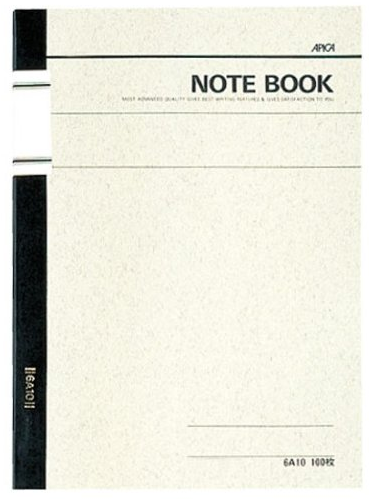
And, frankly, it is upsetting. The diary that I lost is an Apica notebook, started in late 2013. The thought that I have lost the record of that time is hard to take — not because I was a consistent writer during this period or because I had anything important or lyrical to say — I’ve read too many really good diaries to recognize that my own is not particularly “good” in an aesthetic or literary sense. But, the record of those years is meaningful to me. This past year has been a really difficult one for my family; we’ve experienced some life-altering challenges, which I wrote about as they happened. I want to have those words somewhere, to know that they are there if and when I want to read them again. The thought that those words have disappeared makes them seem, suddenly, all the more precious and important.

I worry that somehow my diary was thrown away. In my more paranoid moments, I imagine that someone came into the house and took my diary. Who would that be? A very selective and ineffective thief? House elves? I know it’s illogical but I can’t quite shake the image of a stranger somewhere reading and cackling over my diary.

Under normal circumstances, this is the kind of experience I would write about in my diary but I cannot bring myself to start a new diary. I have not given up hope that it’s going to turn up. But I feel incomplete not having one; I’ve kept a diary regularly for over 25 years. 25 years and I’ve never lost a diary before. It’s very, very peculiar.

UPDATED: I found my diary. Almost two weeks later. In the most obvious place, where I swear I looked several times but, apparently, I did not see what was right before my eyes. I’m relieved, a little wierded out, but definitely relieved.

Diary Tweets: Trapper Bud’s Diary

Screen Shot 2015-02-27 at 1.07.07 PM

It’s a pretty common perception that social media platforms like blogs and Facebook are modern iterations of the diary. You’ll see that argument made by academics who study contemporary life writing, by journalists who are interested in the development and use of social media, and by bloggers and Facebook-ers themselves. These different forms of self-expression have some things in common: they are self-disclosing records of life, often daily, usually mundane, and sometimes extremely private. There are obvious differences, of course — differences that have been analyzed closely by literary critics — notably that social media makes the text available to an audience of strangers and that the audience engages with, responds to, and essentially collaborates on the text.

Twitter, however, seems to be of another species altogether. Generally speaking, Twitter is less about individually recorded lives and more about conversation, debate, and sharing. You are much less likely to encounter the argument that Twitter is like, in any way, a diary — and I tend to agree with that distinction. If I were to make analogies, I would be more likely to compare Twitter to a telegram, to newspaper headlines, or to the running scroll at the bottom of the TV screen — short, impersonal announcements about events occurring in the public sphere.

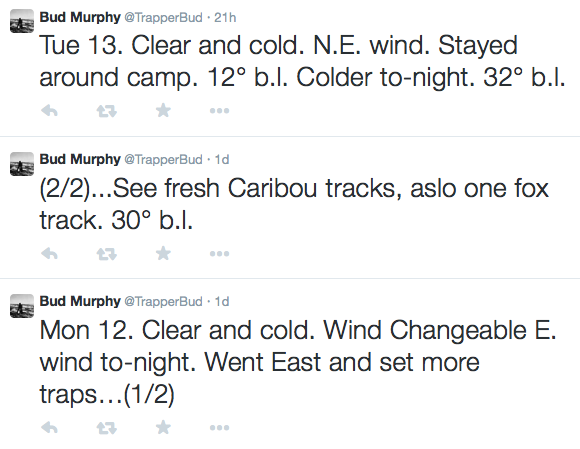
Derryl Murphy is breaking down such distinctions with his @TrapperBud Twitter feed, where he is tweeting his grandfather’s diary. Bud Murphy was a trapper in the Northwest Territories in the 1920s and 30s and kept a daily record of his experiences. Derryl illuminates Bud’s narrative with illustrations and occasional commentary on his grandfather’s life. Here’s a post from Derry’s blog discussing the Twitter project. It is an intriguing use of Twitter: part recovery, part publication, part personal narrative. Plus, Bud lived a really incredible life — the kind of life that seems increasingly impossible in our world, one tied to nature and nature’s rhythms. I would love to know more about why Bud kept the diary in the first place. In the meanwhile, I look forward to seeing Bud’s “voice” intermingling with other tweets in my Twitter feed.